If you own in an older oceanfront building on Miami Beach, there is a number from this week's news that I would pay attention to. It is not a price per square foot. It is 163 out of 172.
That is how many units in the Port Royale condominium, at 6969 Collins Avenue in North Beach, the Kolter Group and BH Group joint venture now controls, according to Commercial Observer's October 2 reporting. The buyers have put in roughly $61.6 million since July, which works out to about $378,000 a unit on average (that division is mine, but it lines up with the roughly $380,000 a unit reported when the first ten units traded in July). Nine units are left. And the developers have just filed to demolish the neighboring Normandy Plaza Hotel to make room for a 17-story, 37-unit oceanfront condo tower designed by Kobi Karp.
I read this as more than a North Beach deal story. It is a live, public case study in a question a lot of Miami Beach owners are quietly asking: what is my aging building actually worth, and to whom?
What actually happened at Port Royale
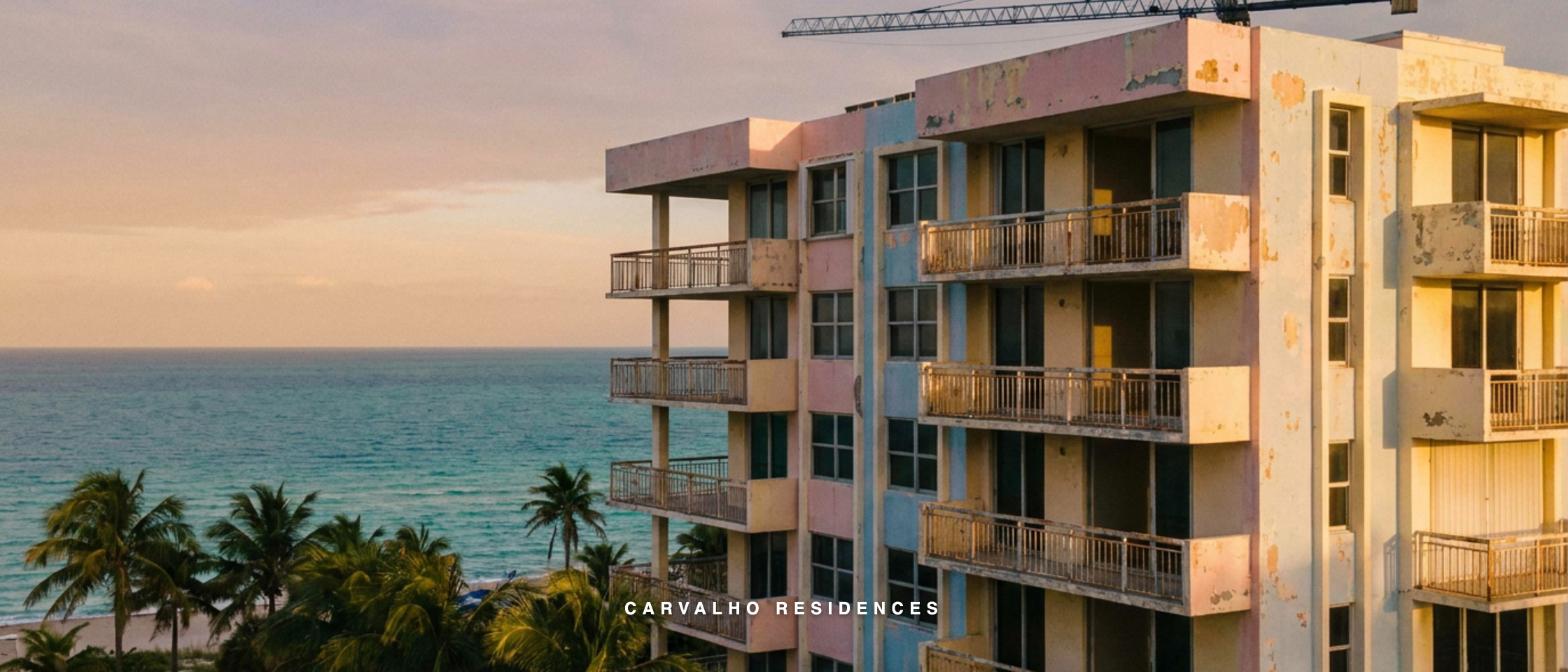
The building is a 14-story, 172-unit condominium from 1971. Residents were asked to evacuate in 2022 after engineers found damage to a beam in the mezzanine-level garage, and they returned after about a month. It has carried a structural-integrity question mark ever since, which is exactly the profile of a lot of Collins Avenue stock.
Here is the assemblage as reported, piece by piece:
Normandy Plaza Hotel (6985 Collins): bought in 2023 for $18 million. Three stories, built in 1950.
Crystal Beach Suites (6979 Collins): the residential portion bought in January 2026 for $26 million, then the commercial condos in July for $14.4 million.
Port Royale (6969 Collins): ten units for about $3.7 to $3.8 million in July, and 163 of 172 units owned as of this week.
The financing: Wells Fargo has reportedly increased its construction loan to $83.2 million, double the January figure.
The combined oceanfront site is about two acres between 69th and 71st Streets. The reported prices across the four pieces add up to roughly $120 million (my arithmetic). According to the same reporting, the venture had marketed a one-acre section of the site for $110 million last year, which tells you what the developers think the land is worth once it is assembled.
💡 What I tell owners: an assembled oceanfront acre is worth far more than the sum of its parts. The people who own the last unit in a buyout have the most leverage. The people who sit in the middle of the pack, wondering, often have the least.
Why this matters for a Miami Beach seller
Owners in 1960s and 1970s oceanfront buildings usually weigh two options: sell at a discount that reflects reserves and assessment risk, or hold and pay. Port Royale shows a third worth a real look: the building as a land play.
That does not apply to every building. It applies when the site is oceanfront or otherwise scarce, when the structure is old enough that rebuilding beats repairing, and when there is a developer with the capital and the patience to assemble it. North Beach has all three right now. The Wells Fargo loan doubling and a $1.1 billion construction financing for Mercedes-Benz Places in Brickell (reported by Commercial Observer last week) are two examples of lenders still willing to fund new Miami condo product.
There is also a demand signal behind the towers. Miami Realtors reports that Miami-Dade recorded 194 home sales of $10 million or more through August, already 14.1% above all of 2025's 170, on pace to break the 2021 record of 230. That is a countywide figure and not specific to the Beach, but it is the kind of buyer who writes the check for a new 37-unit oceanfront tower.
The part nobody explains: the rules behind a buyout
Here I want to be careful, because I am not an attorney and this is where owners get hurt by half-remembered rules. In general, Florida's optional-termination statute (§718.117) requires approval from at least 80% of a condominium's voting interests, and a plan generally cannot proceed if 5% or more of the voting interests reject it. When a single bulk owner holds 80% or more, the statute says the remaining owners must receive at least 100% of fair market value, determined by an independent appraiser, and for homesteaded units the floor is at least the original purchase price. Per Florida's Senate statute text, a rejected plan cannot be brought back for 24 months.
Two caveats matter a lot. First, I do not know how Kolter and BH are structuring the endgame at Port Royale. The reporting describes unit-by-unit purchases, not a termination plan. Second, older declarations can work differently. Florida's condo-law attorneys have been writing this year about a 2025 case, Avila v. Biscayne 21 Condominium, in which a court held that an older declaration requiring unanimous approval gave every owner an effective veto. Whether your building's declaration lets the modern statute apply is a question for a condo attorney, and it should be answered before you talk to any developer.
What I would do if I owned in an older Miami Beach oceanfront building
Read your declaration, not just your budget. Find out how it handles termination and amendments. That one document decides whether you have a collective option at all.
Get two numbers, not one. What an end user will pay for your unit today, and what the site is worth to a developer. They can be very far apart, and the gap is your negotiating room.
Know the reserve and assessment picture. A building facing large near-term assessments sells at a different price than one with funded reserves. Buyers, including developers, will price it in.
Do not sell cheaply to an "assemblage" buyer without comps. If someone is knocking on doors, you are in someone else's spreadsheet. Ask what the building's land value looks like at the unit level before you sign.
If you are an investor: buildings like this are where the next assemblages come from. Look at oceanfront or near-oceanfront 1960s to 1970s stock with structural questions, aging reserves and a large share of absentee owners. That is how Port Royale started.
The bottom line
The Port Royale story is not a promise that your building is next. Most are not. But it proves that old Miami Beach oceanfront can be worth more as land than as apartments, that serious lenders will fund the replacement, and that the owners who know their options early are the ones who get paid for them. If you own in an older Miami Beach building, the wrong move is to wait until a buyer tells you what it is worth.
Own on Miami Beach and curious what your unit would sell for today, or what your building could be worth to a developer? I will run you a real number, based on actual comparables, your building's reserves and assessment history, and the site value. No pressure, no pitch.
Looking to buy or invest on the Beach? Let's find your place. I'll show you the buildings where the numbers actually work.
👉 Message me on WhatsApp | ✉️ silvana@carvalhoresidences.com | 📞 +1 (786) 767-0131
Frequently asked questions
What is happening at Port Royale in North Beach?
According to Commercial Observer's October 2, 2026 report, Kolter Group and BH Group control 163 of the 172 units at the Port Royale condominium at 6969 Collins Avenue, with about $61.6 million invested since July. They are assembling a roughly two-acre oceanfront site and plan a 17-story, 37-unit condo tower.
How much did the developers pay per unit?
Roughly $378,000 per unit on average, based on the $61.6 million reported for 163 units. When ten units traded in July, reports put the figure near $380,000 per unit. These are averages and unit sizes vary, so they are not a price per square foot.
Can a developer force me to sell my Florida condo?
In certain circumstances, yes. Florida's optional-termination law generally requires approval of at least 80% of voting interests, and a plan generally cannot proceed if 5% or more reject it. When a bulk owner holds 80% or more, remaining owners must be paid at least fair market value. Older declarations can differ, so ask a Florida condo attorney about your building.
Is my older Miami Beach building a redevelopment candidate?
Oceanfront or scarce sites with older structures, large near-term repair costs and many absentee owners tend to attract assemblage interest. It depends on the land, zoning and your declaration, and a local market analysis is the right first step.
Sources: Commercial Observer, "Kolter, BH Inch Toward Buyout on Oceanfront Miami Beach Condo" (Oct. 2, 2026) and "Kolter Expands Miami Beach Assemblage for Condo Dev With BH Group" (July 2026); Bisnow South Florida Deal Sheet (July 13, 2026); The Real Deal (Jan. 22 and July 10, 2026); Commercial Observer on Mercedes-Benz Places Miami financing (Sept. 2026); MIAMI REALTORS and RWorld, Miami-Dade $10M+ sales (Aug. 2026 statistics); Florida Statutes §718.117 (2025); Florida Condo and HOA Law Blog on Avila v. Biscayne 21 (Feb. 2026). Figures are as reported by those outlets; per-unit average and combined acquisition total are my own arithmetic. This is general information, not legal, tax or investment advice.